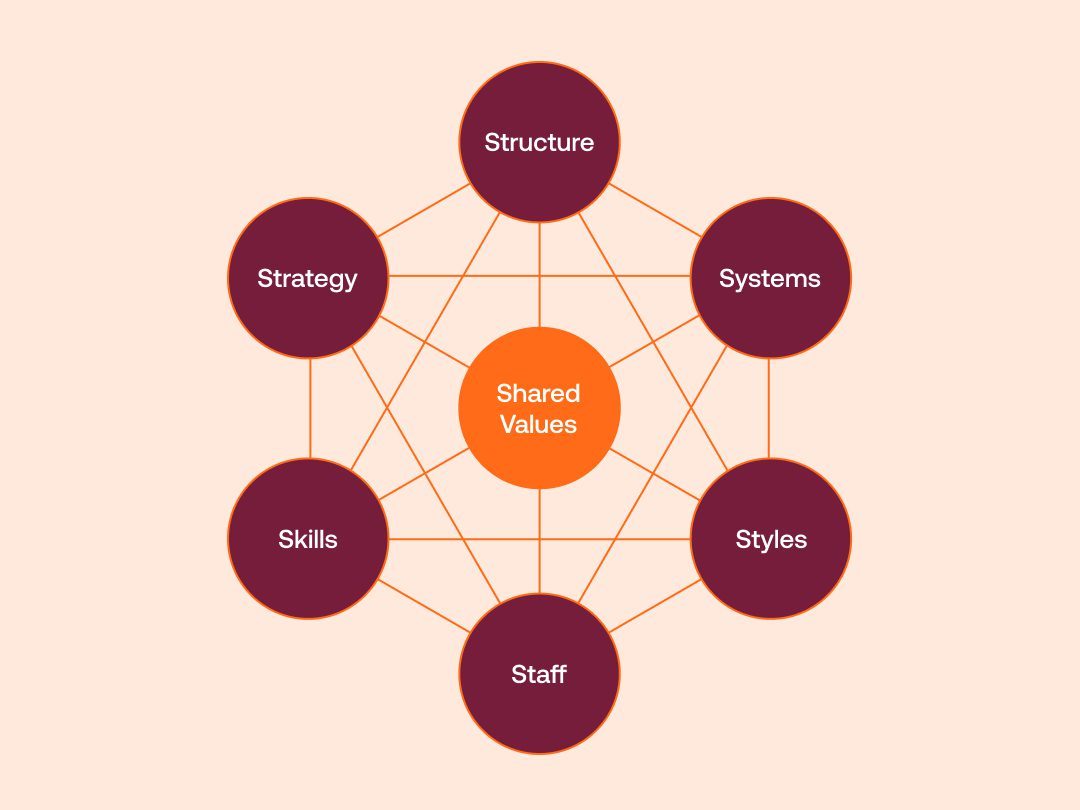
I first encountered the 7S McKinsey Framework the way many people do: as a neat diagram in a slide deck, cleanly labeled, reassuringly symmetrical. Strategy. Structure. Systems. Skills. Staff. Style. Shared Values.
Seven elements, all aligned, all tidy:
Real life, of course, is none of those things.
Over time, I’ve learnt to value the 7S framework as a lens that helps bring to light the unseen conflicts we frequently overlook until something goes wrong rather than as a checklist to “fix” organisations.
Friction is more important than boxes.
What the 7S model does well is surprisingly straightforward: a single poor choice does not lead an organisation to fail. Misalignment is the reason they fail.
Even if you have an excellent plan, it will never leave PowerPoint if your structure causes decision-making to be excruciatingly sluggish.
You can make significant investments in new processes, but they will be circumvented or silently opposed if your employees don’t trust the leadership style.
People with amazing skills can be hired, but they will tug in various directions if your shared ideals are ambiguous or performative.
The structure serves as a reminder that friction typically exists in the spaces between these components rather than being random.
The “Soft” S’s Aren’t Soft at All
I made the error of first viewing the other levers as cultural garnish and Strategy, Structure, and Systems as the “real” levers. Experience swiftly dispelled that delusion.
Style is what people learn is safe, not merely how leaders act.
Employee morale, trust, burnout, and ambition are more important than headcount.
Shared values are what are truly appreciated when no one is around. They are not just catchphrases.
The so-called hard aspects crumble under their own weight when these are disregarded. Culture never stops collecting its obligation.
Alignment Is Ongoing, Not Achieved
One thing that should be stated clearly in the 7S framework is that alignment is just temporary.
Markets fluctuate. People go. Leaders develop, or don’t. Systems get older. What was effective two years ago may subtly become the cause of today’s annoyance. The framework functions best when applied frequently, much like a diagnostic check-in:
Has our structure changed more slowly than our strategy?
Do our systems accurately depict the nature of work?
Are we hiring people with skills that don’t align with our goals?
Do actual decisions still reflect our values?
Assuming alignment is permanent poses a greater risk than misalignment per se.
A Tool for Conversations, Not Control
The 7S framework does not, at best, offer solutions. Better questions are produced as a result.
When used effectively, it initiates discussions that are typically avoided:
Why, in spite of “successful” outcomes, do people feel worn out?
Why does each reorganisation cause execution to slow down?
Even if we claim to encourage innovation, why does it feel dangerous here?
When misused, it turns into just another managerial exercise that diagnoses everything but makes no changes.
Final Reflection
The 7S McKinsey Framework is not a road map for achieving organisational excellence. It’s a mirror. Additionally, mirrors aren’t always cosy.
However, it offers something unique if you’re prepared to look honestly, particularly at the delicate, messy, human parts: a way to comprehend why things seem wrong before they break down.
And occasionally, that comprehension is the best course of action.