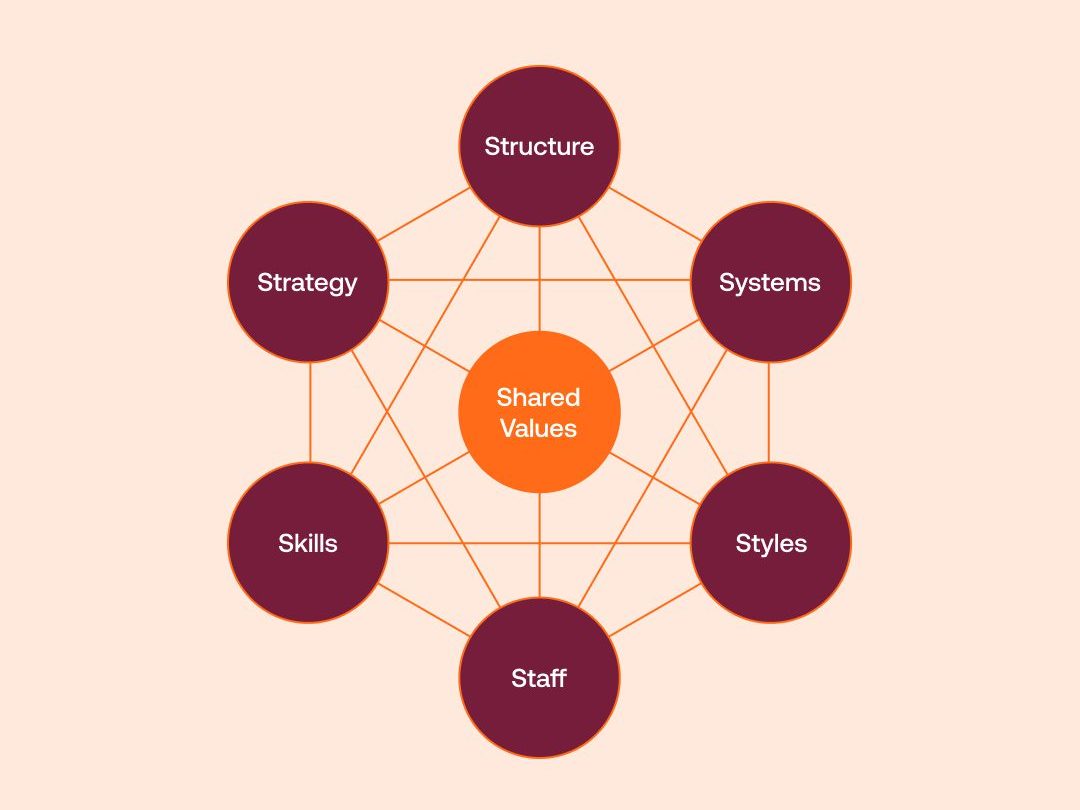
I first encountered the 7S McKinsey Framework the way many people do: as a neat diagram in a slide deck, cleanly labeled, reassuringly symmetrical. Strategy. Structure. Systems. Skills. Staff. Style. Shared Values.
Seven elements, all aligned, all tidy:
Real life, of course, is none of those things.
Over time, I’ve come to appreciate the 7S framework not as a checklist to “fix” organizations, but as a tool that helps surface the invisible tensions we often ignore until something breaks.
It’s Not About Boxes; It’s About Friction
What the 7S model gets right is deceptively simple: organizations don’t fail because of a single bad decision. They fail because of misalignment.
You can have a brilliant strategy, but if your structure makes decision-making painfully slow, the strategy never leaves PowerPoint.
You can invest heavily in new systems, but if your staff doesn’t trust leadership’s style, those systems will be bypassed or quietly resisted.
You can hire people with incredible skills, but if your shared values are unclear or performative, those skills pull in different directions.
The framework reminds me that friction isn’t random, it usually lives in the gaps between these elements.
The “Soft” S’s Aren’t Soft at All
Early on, I made the mistake of seeing Strategy, Structure, and Systems as the “real” levers, and the others as cultural garnish. Experience corrected that illusion quickly.
Style isn’t just how leaders behave: it’s what people learn is safe.
Staff isn’t headcount: it’s morale, trust, burnout, ambition.
Shared Values aren’t slogans: they’re what actually gets rewarded when no one is watching.
When these are ignored, the so-called hard elements collapse under their own weight. Culture always collects its debt.
Alignment Is Ongoing, Not Achieved
One thing the 7S framework doesn’t say explicitly, but should, is that alignment is temporary.
Markets change. People leave. Leaders grow (or don’t). Systems age. What worked two years ago can quietly become the source of today’s frustration. The framework works best when used repeatedly, almost like a diagnostic check-in:
- Has our strategy evolved faster than our structure?
- Do our systems reflect how work actually happens?
- Are we hiring for skills that no longer match our direction?
- Do our values still show up in real decisions?
The danger isn’t misalignment itself, it’s assuming alignment is permanent.
A Tool for Conversations, Not Control
At its best, the 7S framework doesn’t provide answers. It creates better questions.
Used well, it opens conversations that are usually avoided:
- Why do people feel exhausted despite “successful” results?
- Why does execution slow down after every reorganization?
- Why does innovation feel risky here, even when we say we want it?
Used poorly, it becomes another managerial exercise that diagnoses everything and changes nothing.
The Quiet Power of Shared Values
If I had to pick the most underestimated element, it would be Shared Values.
Not because they are lofty — but because they are gravitational. They pull every other “S” into orbit, whether leaders acknowledge it or not. When values are lived, alignment becomes easier. When they’re hollow, no amount of restructuring or system upgrades will compensate.
People don’t align with frameworks. They align with meaning.
Final Reflection
The 7S McKinsey Framework isn’t a map to organizational perfection. It’s a mirror. And mirrors aren’t always comfortable.
But if you’re willing to look honestly — especially at the soft, messy, human parts — it offers something rare: a way to understand why things feel off before they fall apart.
And sometimes, that understanding is the most strategic move of all.
Leave a Reply